Jerry Sewell
The OutlawsJerry Sewell is the J Bar’s boss and the suspected organizer of a horse-theft operation concealed behind cattle work. Seen through Del Delaney’s wary observations, he is a guarded, isolated figure: his crew’s black clothing and horses, their attention to the newly driven stock, and his own frightened response to Bull Hammer’s arrival all make the ranch’s apparent respectability look uncertain. The novel leaves the suspicion grounded in the characters’ deductions rather than presenting a full account of Sewell’s crimes or eventual fate.
Position at the J Bar
Sewell is introduced as the ranch boss, but his authority appears limited in an important way. Del concludes that Stub Rawls, the foreman, can effectively decide whom to hire or fire and may even have influence over buying and selling. Sewell does not seem to know or care which hands have worked at the J Bar before; he treats Del, The Kid, and John Smith as if they were simply part of an established crew. His title places him at the head of the outfit, yet the day-to-day power Del observes seems to rest substantially with Rawls.
Sewell’s distance extends beyond the three newcomers. Del sees him pay little attention to most of the crew, and at supper Sewell and the four men who had helped bring in horses sit apart at the end of the long table. They speak to the other hands only briefly, exchanging a few words with Rawls. The arrangement gives the group a conspicuous separation within the ranch: Sewell is not shown building trust or fellowship with the workers around him, but keeping company with a small, self-contained party.
Appearance and Conduct
Del describes Sewell as lanky, with dark eyes that move nervously from one thing to another and rarely settle for long. Del speculates that this restlessness might come from a life spent on the run, but explicitly has no knowledge that Sewell has been or is a fugitive. The distinction matters: the impression contributes to Sewell’s atmosphere of concealment, but it is Del’s conjecture, not an established biography.
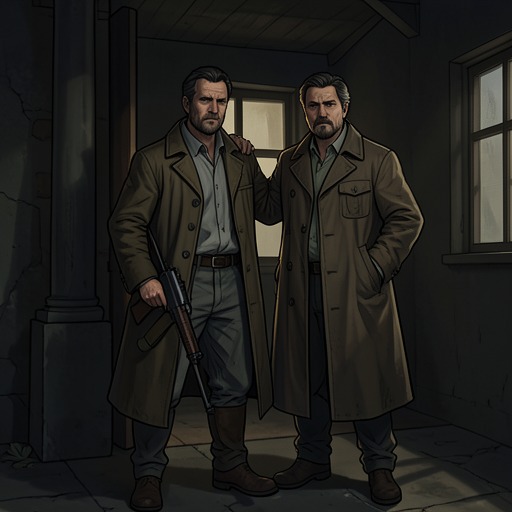
The visual uniform of Sewell’s group makes that atmosphere more pronounced. All five men wear black from boots to Stetsons and ride black horses. Del notices the coordinated appearance but initially keeps his question to himself. Afterward, he and his companions interpret the dark clothing as practical cover for working at night. The detail operates both as an observable fact and as a clue: the group looks organized, and its chosen appearance appears suited to activity they do not want easily seen.
The Horse-Theft Suspicion
The suspicion takes shape when Sewell and his four companions bring horses to the J Bar and discuss them at the corrals, pointing toward individual animals. The next morning, Sewell and the same four men prepare to brand the horses. To Del and John Smith, the stock does not fit an innocent explanation. Smith concludes that Sewell is a horse thief and that the cattle business may be a front; he reasons that the horses could fetch a good price in Colorado, where the law would not be looking for them. Del agrees that Colorado may be their destination, and Smith connects the men’s black clothes with the advantage of working at night.
These judgments are the newcomers’ interpretation of what they see, not a narrated confirmation of every element of the alleged scheme. Still, the sequence gives their suspicion concrete grounds: the unusual group, the attention paid to the horses, the planned branding, and the possibility of moving the animals beyond the reach of the authorities looking for them. Sewell’s role as boss makes him central to the suspicion, although the evidence does not specify precisely what each man in the group does or establish the full extent of Sewell’s involvement.
Bull Hammer and Del Delaney
When Bull Hammer and his deputy, Rip Hughes, arrive at the J Bar, Rawls calls out to Sewell that they have visitors. Sewell recognizes the riders, starts toward Rawls, and then stops about ten feet away. Del is struck by how frightened Sewell looks, describing him as visibly terrified despite his hardcase reputation. The contrast between Sewell’s earlier control at the corrals and his response to Hammer suggests that the arrival carries a danger he cannot simply manage through his position at the ranch.
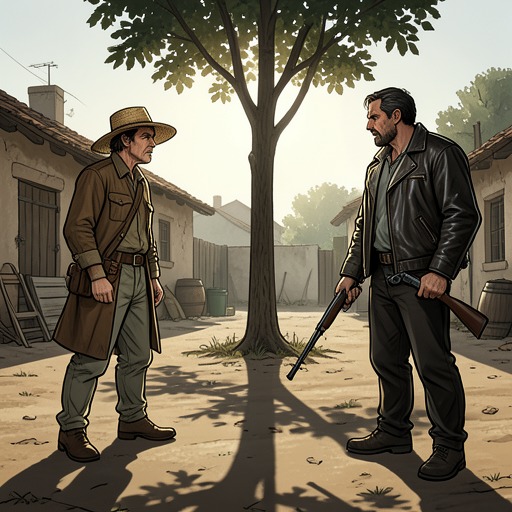
After Del’s fight with Hammer, Rawls warns Del to make himself scarce because Hammer will kill him if he catches up. Sewell then approaches Del, trembling with anger, and blames him for making an enemy of Hammer, coming to hide at the J Bar, and bringing the lawman down on the rest of them. He threatens to beat Del. Del is too shaken and depleted from the fight to answer as he normally might, and The Kid intervenes, warning Sewell not to touch him. The confrontation shifts Sewell from a suspicious, watchful presence into an immediate threat to Del, while also revealing that he sees Del’s conflict with Hammer as a danger to the entire outfit.
Narrative Role and Limits
Sewell helps turn the J Bar from a temporary place of work into a setting of concealed risk. His authority is qualified by Rawls’s practical control; his crew’s secrecy encourages the horse-theft theory; and his fear at Hammer’s arrival hints at the pressure behind his hardcase manner. His later threat is not an isolated display of temper in the scene: he explicitly links it to Del’s presence and to the danger he believes Del has brought to the ranch.
The account remains deliberately limited to Del’s perspective. Sewell’s restless eyes prompt a guess about his past, while the horse operation is described through what Del and John Smith infer from the men’s conduct. The available events do not disclose Sewell’s subsequent fate or settle every suspicion about his business. His characterization therefore rests on a tension between apparent authority and insecurity: he commands a small, separated group, but the arrival of a more formidable lawman exposes fear, and his response to Del is to threaten force rather than explain himself.